


Resinous Coating Coverage Rates & Concrete Porosity
Posted by Floorguard Products on Oct 1st 2026
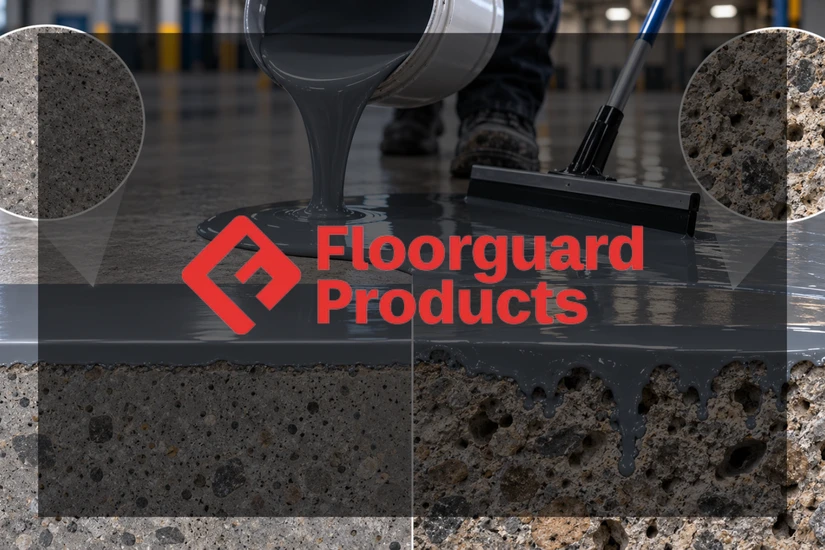
Understanding Resinous Floor Coating Coverage Rates: The Impact of Concrete Porosity
When a resinous flooring product lists a coverage rate of 200 square feet per gallon, it is easy to assume that one gallon should cover exactly 200 square feet on every project.
In the field, it rarely works that simply.
Published coverage rates provide an important application guideline, but actual material consumption can be affected by the condition of the concrete, surface preparation method, resulting surface profile, porosity, application technique, and required film thickness.
Understanding these variables is especially important with primers and basecoats applied directly to concrete.
A dense, hard slab and a soft, highly absorptive slab may both be properly prepared to the same general Concrete Surface Profile (CSP), yet require noticeably different amounts of material to achieve the same finished film.
The reason is straightforward:
Some concrete surfaces consume more resin than others.
Coverage Rate Starts With Film Thickness
For liquid coatings, coverage and film thickness are directly related.
One U.S. gallon contains approximately 231 cubic inches of material. For a 100% solids coating, the theoretical relationship between coverage and wet film thickness is:
Coverage (sq. ft./gal.) = 1,604 ÷ Film Thickness (mils)
This produces the following theoretical coverage rates:
- 4 mils → 401 sq. ft./gal.
- 6 mils → 267 sq. ft./gal.
- 8 mils → 200 sq. ft./gal.
- 10 mils → 160 sq. ft./gal.
- 12 mils → 134 sq. ft./gal.
- 16 mils → 100 sq. ft./gal.
- 20 mils → 80 sq. ft./gal.
This mathematical relationship is extremely useful, but it represents a theoretical condition.
For example, applying one gallon of a 100% solids coating uniformly over 200 square feet represents approximately an 8-mil wet film.
That does not necessarily mean there will be a uniform 8-mil coating above every real-world concrete surface.
Where Does the Material Go?
Concrete is not perfectly smooth, nonporous, or uniform.
When a primer or coating is applied directly to prepared concrete, the resin must first wet and conform to the surface. Material can be consumed by several conditions:
Surface Profile – Resin fills the peaks, valleys, and irregularities created during mechanical preparation.
Surface Porosity – Resin can penetrate into open pores and capillaries in the concrete's near-surface matrix.
Surface Defects – Pinholes, bugholes, small voids, cracks, and other irregularities can consume additional material.
Application Loss – Material remaining in mixing containers, rollers, squeegees, tools, and other equipment also reduces actual field yield.
The published coverage rate therefore should not be viewed as a guarantee that every gallon will produce the same finished film on every concrete floor.
Surface Profile and Porosity Are Different
One of the most important distinctions when discussing coating consumption is the difference between surface profile and surface porosity.
Surface Profile
Surface profile describes the physical texture of the prepared concrete surface.
Grinding, shot blasting, scarifying, and other preparation methods remove material and create different degrees of surface texture.
As the profile becomes more aggressive, the coating must fill deeper valleys and conform to greater surface area.
All else being equal, a more aggressive profile generally consumes more resin.
Surface Porosity
Porosity describes the ability of the concrete's near-surface structure to absorb liquid.
Two slabs can have similar surface profiles while behaving very differently when resin is applied.
One may be hard and dense with relatively little absorption.
The other may be softer, more open, and significantly more absorptive.
This is why CSP alone does not determine coating consumption.
Concrete Hardness Can Provide an Important Clue
Concrete surface hardness can help identify conditions that may affect coating consumption.
Consider two properly prepared slabs.
The first is dense concrete with relatively high surface hardness. Once prepared, relatively little resin may penetrate into the substrate.
The second has a softer, more porous cement paste at the surface. Resin may penetrate considerably deeper before a continuous film develops.
Mohs scratch testing can be useful for evaluating relative surface hardness, but it should not be treated as a direct measurement of porosity.
Likewise, compressive strength alone cannot determine coating coverage.
A 2,000 psi slab does not automatically require a predetermined percentage more material than a 4,000 psi slab.
These measurements provide useful information about the substrate, but the actual behavior of the prepared surface ultimately determines resin demand.
Why Porous Concrete Reduces Coverage
Consider a 100% solids epoxy basecoat intended to be applied at approximately:
200 sq. ft./gal. = 8 mils theoretical film thickness
On a dense, relatively smooth prepared surface, much of the applied material remains within the coating layer.
Now consider a highly porous surface.
Some of the same gallon penetrates into the concrete and fills surface irregularities before the coating establishes its continuous film.
If the installer continues stretching that gallon across the full 200 square feet, less material remains available to create the intended film above the substrate.
The result can be a coating that technically achieved the planned square feet per gallon while failing to achieve the intended film build and surface condition.
That distinction is critical.
The Goal Is Film Build—Not Maximum Square Footage
Contractors naturally pay close attention to coverage because material consumption affects both estimating and production.
But maximizing square footage per gallon should never become more important than installing the material at the appropriate thickness.
If a coating is intended to be installed at 8 mils, the objective is to produce the required film—not simply make each gallon cover 200 square feet.
Trying to force published coverage over a substrate that requires additional material can result in:
- Thin or starved areas
- Uneven film thickness
- Poor hiding or color variation
- Pinholes
- Incomplete pore closure
- Reduced broadcast acceptance
- Visible substrate texture
- Increased potential for outgassing defects
- Inconsistent appearance
In severe cases, excessive absorption may justify a separate primer or additional coat rather than simply increasing the thickness of the primary coating.
Why Priming Porous Concrete Matters
One purpose of a properly selected primer is to help condition the concrete before subsequent resinous flooring layers are installed.
On porous concrete, a primer can help:
- Wet the substrate
- Penetrate the near-surface pore structure
- Reduce differential absorption
- Seal surface porosity
- Promote a more uniform receiving surface
- Reduce the potential for pinholes
- Reduce outgassing-related defects
- Improve consistency of subsequent coating thickness
A highly absorptive floor may require more primer than originally estimated.
In some cases, a second application may be necessary to achieve the desired substrate condition.
The goal should not be to stretch the primer to a predetermined square footage when the concrete clearly requires additional material.
The goal is to properly condition the substrate for the flooring system that follows.
Surface Preparation Also Changes Coverage
Proper mechanical preparation is essential for resinous flooring performance.
However, contractors should recognize that preparation changes the surface onto which the coating will be installed.
A more aggressive surface profile creates additional texture that must be filled.
For example, material consumption over a relatively uniform CSP 2 surface may differ from consumption over an aggressively shot-blasted CSP 4 surface.
That does not mean the floor should be under-prepared to improve coverage.
Surface preparation should always be appropriate for the coating or flooring system being installed.
Instead, contractors should account for the resulting surface condition when estimating material requirements.
Prepare the floor for the system—not for the coverage rate.
Watch for Outgassing
Porous concrete also deserves additional attention because of its relationship with outgassing.
Concrete contains air within its pore structure. As slab temperature increases, this air can expand and move toward the surface.
If a coating is still liquid while air is escaping from the concrete, bubbles can travel through the coating and leave pinholes, craters, or other defects.
For this reason, environmental conditions and substrate temperature trends should be considered when coating porous concrete.
Simply applying additional material does not necessarily solve an active outgassing condition.
The substrate must be properly prepared and conditioned, and the coating should be installed under suitable environmental conditions.
Estimating Material on Porous Floors
When substrate condition is uncertain, contractors should avoid assuming that theoretical coverage will equal actual field coverage.
A better approach is to evaluate the floor after surface preparation.
Look for:
- Soft or weak surface paste
- High absorption
- Aggressive surface profile
- Exposed aggregate
- Bugholes or surface voids
- Previous repairs
- Areas with noticeably different concrete density
- Excessive dusting after preparation
- Differences between old and newly placed concrete
A representative test area can provide valuable information about actual consumption before the entire installation begins.
Record how much material is used over a known area and evaluate the resulting surface.
If one gallon only produces the desired condition over 160 square feet, continuing to force the material to 200 square feet simply because 200 was the estimated coverage rate does not correct the substrate condition.
It creates a thinner coating.
Theoretical, Published and Actual Coverage
A useful way to understand coating coverage is to separate it into three categories.
Theoretical Coverage is the mathematical relationship between material volume and film thickness.
Published Coverage is the manufacturer's recommended application rate or range for the product.
Actual Field Coverage is the material consumption required to achieve the appropriate film and surface condition over the specific prepared substrate.
On ideal concrete, these values may be very close.
On highly porous or aggressively prepared concrete, actual field consumption can be considerably greater.
The Floor Determines Actual Consumption
Published coverage rates are essential for estimating materials and establishing proper application thickness, but they should always be considered in conjunction with the condition of the prepared substrate.
Concrete varies.
Surface preparation varies.
Porosity varies.
And because those conditions vary, actual coating consumption can vary as well.
The most important principle for contractors is:
Coverage rate is a means of achieving the required film thickness—not the performance objective itself.
If the specified application requires a particular film build, the coating must be installed at the rate necessary to achieve that film within the product's published application limits.
Do not sacrifice film thickness simply to reach a predetermined square-foot-per-gallon number.
Evaluate the concrete. Prepare it correctly. Account for its porosity. Then apply enough material to build the floor the system was designed to deliver.
That is the difference between estimating coverage and engineering a successful resinous flooring installation.