


Why 100% Solids Epoxy Coatings Separate (and How to Fix It)
Posted by Floorguard Products on Aug 13th 2026
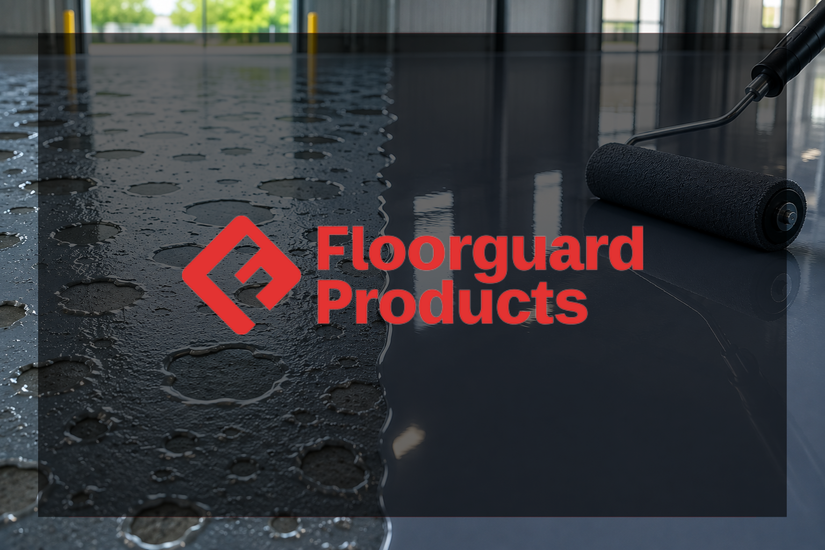
Separation in 100% Solids Epoxy Coatings: Why Dwell Time and Delayed Backrolling Can Improve Film Formation
Introduction
One of the more frustrating application defects encountered with pigmented 100% solids epoxy coatings is commonly described in the field as separation, crawling, fisheying, pulling apart, opening, or rejection.
The appearance can vary considerably. An installer may observe small circular openings, irregular islands, streaks behind a roller, areas where the coating appears to retract from itself, or larger sections where a freshly applied uniform film begins separating minutes after placement.
These symptoms are often immediately attributed to contamination. Oil, silicone, wax, tire dressing, cleaning residue, solvent residue, or other surface contaminants absolutely can cause coating rejection and must remain part of the investigation. However, not every separation condition is caused by contamination.
In high-solids and 100% solids epoxy systems, separation can also result from the interaction between:
surface tension → substrate surface energy → wetting → viscosity → flow and leveling → pigment/additive loading → film thickness → application shear → time.
This becomes particularly important with relatively long-open-time epoxy materials such as HyperREZ UV, HyperBOND, and DT 454, where the coating remains mobile long enough for the film to continue changing after initial placement.
In these circumstances, additional dwell time before application and delayed backrolling can sometimes materially improve the finished film.
The reason is not that waiting somehow "fixes" contaminated concrete. Rather, additional time can allow the mixed resin system to stabilize, entrained air to escape, components and pigments to become more uniformly incorporated, and the coating already on the floor to establish more complete wetting and leveling before additional roller shear is introduced.
The result can be a more stable continuous film.
Understanding Surface Tension
Liquids naturally attempt to minimize their exposed surface area.
The molecular forces responsible for this behavior are commonly described in terms of surface tension.
At the surface of a liquid coating, molecules experience a different balance of intermolecular forces than molecules within the bulk liquid. This creates an energetic tendency for the liquid surface to contract.
For a coating to spread uniformly across a substrate, the coating must overcome that tendency sufficiently to wet the surface.
The fundamental relationship is therefore not simply:
"Is the floor clean?"
It is:
"Does the liquid coating have sufficient wetting capability relative to the surface energy and condition of the substrate?"
A mechanically prepared surface can appear extremely clean and still present localized differences in wetting behavior.
Conversely, a properly formulated coating applied to a compatible, adequately prepared substrate normally spreads because the energetic relationship favors wetting rather than contraction.
Surface Energy and Wetting
The substrate possesses surface energy, while the liquid coating possesses surface tension.
For good coating wetting, the energetic relationship between the two must allow the liquid to spread rather than bead or retract.
A useful conceptual model is:
Higher-energy substrate + sufficiently low coating surface tension → favorable wetting
whereas:
Low-energy surface + comparatively high coating surface tension → poor wetting / retraction / crawling
This is why silicone is so problematic.
Silicone contamination can dramatically lower localized surface energy. A coating that wets the surrounding concrete perfectly may retract from a microscopic silicone-contaminated area, producing a classic fisheye.
But contamination is only one way to disturb the wetting relationship.
Localized resin chemistry, pigment concentration, solvent addition, surface additives, previously installed coatings, cleaning residues, application tools, and differences in film thickness can all affect the balance.
Wetting Is a Dynamic Process
Wetting should not be thought of as something that happens instantaneously when epoxy touches the floor.
It occurs over time.
When a liquid coating is initially deposited, it must:
contact the substrate → displace air at the interface → penetrate accessible surface irregularities → spread across the surface → equalize film thickness → relax application-induced stresses → level.
Concrete and mechanically abraded coatings are not molecularly smooth surfaces. They contain peaks, valleys, pores, scratches, and irregularities.
The coating therefore requires some amount of time to establish intimate contact with that surface.
Lower viscosity generally improves this process because the resin can move more easily.
This is one reason temperature has such a significant effect on epoxy application.
As resin temperature increases within the manufacturer's allowable range:
viscosity generally decreases → flow increases → wetting improves → leveling increases.
At lower temperatures:
viscosity increases → flow decreases → wetting becomes slower → roller texture and application disturbances persist longer.
The relationship is not unlimited, because excessive temperature also accelerates chemical reaction and shortens working time.
Flow and Leveling Are Related to Wetting—but Are Not the Same Thing
A coating can wet the substrate yet still exhibit poor leveling.
Likewise, a material can have excellent apparent flow while still experience localized wetting defects.
Wetting describes the coating's ability to establish contact with and spread across the substrate.
Flow describes movement of the liquid coating.
Leveling describes the film's ability to eliminate thickness variations, roller marks, squeegee lines, and other application disturbances before viscosity increases sufficiently to stop movement.
These processes occur simultaneously after placement.
A long-open-time epoxy provides a comparatively large period during which these processes can continue.
That can be extremely beneficial when the installer understands how to use the available working time.
Why Long-Open-Time Epoxies Behave Differently
HyperREZ UV, HyperBOND, and DT 454 are useful examples because they are not designed around extremely rapid film lock.
HyperBOND, for example, is a 100% solids epoxy with approximately 2,000 cps viscosity and a published working time of approximately 35–45 minutes at 70°F. Its published coverage range is approximately 80–160 ft²/gal at 10–20 mils WFT.
HyperREZ UV is also a 100% solids epoxy; published technical information lists approximately 700–1,000 cps mixed viscosity and roughly 40–45 minutes pot life at 70°F for a 1½-gallon mass.
Floorguard likewise identifies DT 454 as a two-component, 100% solids industrial epoxy, distinct from its faster DT 454 Turbo formulation.
These comparatively long working periods are important.
They mean that immediately after mixing and immediately after placement, the coating is nowhere near chemically locked in place.
It remains a mobile liquid film.
That gives the installer an opportunity for:
- wetting;
- flow;
- leveling;
- entrained-air release;
- pigment stabilization;
- redistribution of coating thickness;
- and relaxation of roller/squeegee disturbances.
It also means the installer can repeatedly disturb a film that is trying to establish equilibrium.
Why Immediate Backrolling Can Sometimes Make Separation Worse
Backrolling is necessary in many epoxy applications.
Its purposes can include:
- evening film thickness;
- removing squeegee lines;
- distributing pigment;
- improving visual uniformity;
- orienting the film;
- and creating consistent appearance.
But timing matters.
Immediately after the coating is placed, the film is at its most fluid and has only begun establishing wetting equilibrium with the substrate.
Aggressive or repeated backrolling introduces additional mechanical shear.
The roller picks material up, redistributes it, stretches it into thinner regions, pushes it into thicker regions, and continuously creates new liquid-air and liquid-substrate interfaces.
If the film is already exhibiting marginal wetting stability, immediate repeated manipulation can continuously disturb the film before it has had an opportunity to stabilize.
Instead of:
place → wet → flow → level
the process becomes:
place → partially wet → roll → redistribute → partially wet again → roll again → redistribute again.
The installer can unintentionally keep resetting the film.
What Delayed Backrolling Changes
With a long-open-time epoxy, waiting several minutes before the final backroll can allow the coating to perform some of its own work.
During this period:
substrate wetting continues;
air trapped in surface irregularities can migrate upward;
roller and squeegee disturbances begin relaxing;
the resin flows into surface profile;
localized film-thickness differences begin equalizing;
and
the coating becomes progressively more homogeneous as a continuous film.
The subsequent backroll is therefore being performed on a film that has already established substantially greater contact with the substrate.
The objective is not to wait until the epoxy becomes tacky.
The objective is to use a portion of the available open time before performing the final, minimal corrective backroll.
Why the Improvement Can Appear Counterintuitive
Installers commonly see separation and immediately begin rolling the affected area more aggressively.
That response seems logical:
"The coating is separating, so I need to roll it back together."
Sometimes the area temporarily looks better.
Then several minutes later it opens again.
That behavior is diagnostically important.
It suggests the roller is mechanically redistributing the liquid without necessarily correcting the underlying interfacial or film-stability condition.
The roller forces resin across the opening, making it disappear temporarily. Once the roller leaves and the liquid film is again free to move, surface-energy forces can reassert themselves and the opening returns.
Repeated rolling can therefore become a cycle:
separation → roll closed → temporary uniformity → film relaxes → separation returns → roll again.
When this occurs, additional rolling is not necessarily the solution.
Allowing the film to establish greater wetting and partial rheological stability before one controlled final backroll can sometimes produce a much better result.
Why Dwell Time After Mixing Can Also Help
A separate but related variable is dwell time after mixing but before placement.
This should not be confused with manufacturer-required induction time. Many 100% solids epoxies do not require a formal induction period.
Nevertheless, a short controlled dwell can change the physical condition of a freshly mixed coating.
Mixing introduces substantial mechanical energy.
Immediately after mixing, the resin may contain:
- entrained micro-air;
- local pigment-concentration differences;
- flow patterns from the mixing blade;
- temperature gradients;
- incompletely equilibrated pigment/resin interfaces;
- and temporary rheological effects created by shear.
Allowing the mixed material a short period to settle can permit entrained air to rise and the mixture to become more physically uniform.
This can be especially relevant when field pigment packs are introduced into the Part A before addition of Part B.
The pigment must first disperse throughout the resin component and then remain uniformly distributed when the hardener is incorporated.
Insufficient pigment incorporation, material remaining on the pail wall or bottom, excessive mixing shear, or incompatibility among pigment-carrier components can all affect the final film.
A controlled dwell period can sometimes improve application behavior.
However, this must be used intelligently.
Dwell Time Is Not Free Working Time
Once Part A and Part B are combined, the chemical reaction has started.
The clock is running.
A five-minute dwell does not occur outside the pot life.
It consumes five minutes of it.
Therefore:
usable field working time ≈ available working time − mixing time − dwell time − placement time already consumed.
This becomes increasingly important as material temperature and ambient temperature rise.
A five-minute dwell at 60°F is not equivalent to a five-minute dwell at 90°F.
Warmer material reacts faster, viscosity can begin rising sooner, and the installer has less remaining application time.
Accordingly, dwell time should never be prescribed as an arbitrary universal number.
It should be evaluated relative to:
product → batch size → material temperature → slab temperature → ambient temperature → working time → application area.
Surface Tension Also Explains Why Solvent Addition Is Not a Universal Cure
When separation occurs, installers sometimes add acetone, xylene, or another solvent in an attempt to reduce viscosity and improve flow.
There is a logical basis for the idea.
A compatible solvent can:
reduce viscosity → modify surface tension → increase flow → potentially improve wetting.
But this does not mean solvent addition will correct the problem.
If the actual mechanism is localized low surface energy, pigment incompatibility, silicone contamination, excessive additive concentration, or an unstable coating interface, simply reducing viscosity may not eliminate the driving force causing retraction.
The coating may become easier to move while still wanting to pull away from the same location.
Solvent can also introduce additional variables:
- altered stoichiometric concentration per unit film volume;
- reduced as-applied solids;
- lower resulting DFT;
- increased volatile release;
- greater potential for solvent entrapment;
- changed cure behavior;
- changed flow characteristics;
- and potentially altered regulatory/VOC compliance.
Solvent addition therefore should only be made where permitted by the coating manufacturer and within the published limit.
More flow is not automatically better wetting.
Why Separation Can Occur on a Second Coat
A particularly important diagnostic observation is when the first coat experiences separation and a subsequent coat installed over the cured first coat exhibits the same behavior.
That makes simple substrate contamination less persuasive as the sole explanation.
The second coat is no longer directly interacting with the original concrete or original coating surface.
Its immediate substrate is the newly installed resinous coating.
If essentially the same separation pattern reappears, the investigation should expand toward:
- coating formulation;
- pigment/additive compatibility;
- pigment loading;
- surface tension imbalance;
- application viscosity;
- film thickness;
- mixing procedure;
- solvent addition;
- roller/tool interaction;
- application shear;
- environmental conditions;
- and timing.
It does not mathematically eliminate contamination because contaminants can migrate, transfer, or remain at interfaces.
But repeated behavior across newly generated coating surfaces is strong evidence that the diagnosis should extend beyond simply blaming the original substrate.
Pigment Packs Deserve Particular Attention
Universal pigment packs contain more than pigment particles.
They require a carrier system capable of maintaining pigment dispersion and allowing incorporation into compatible resin systems.
When substantial pigment is introduced into a clear resin, the finished coating is no longer simply the original clear resin with color added.
The mixture's physical characteristics can change.
Depending upon formulation and dosage, pigment addition can affect:
viscosity, density, surface tension, wetting, flow, opacity, cure behavior, and rheology.
This is why manufacturer-approved pigment dosage matters.
It also explains why unusual separation appearing only after pigmentation should trigger comparison testing between:
unpigmented resin
and
the same resin containing the specified pigment pack.
That is a much more informative diagnostic test than repeatedly solvent-wiping the floor.
Film Thickness Matters
Film thickness also influences separation.
A very thin region has less material available to overcome local substrate irregularities and can reveal wetting differences quickly.
A thick region has greater hydrostatic mass and may flow differently but can develop its own problems.
For a 100% solids epoxy:
the applied WFT is approximately the theoretical DFT before allowance for practical application losses and surface profile.
Consequently, actual material consumption should always be evaluated.
For HyperBOND, for example, the current manufacturer data gives approximately 80–160 ft²/gal corresponding to 10–20 mils WFT.
If the material is being stretched substantially thinner than intended, the resulting film can behave differently than the manufacturer's designed application range.
Temperature Changes Everything
Temperature affects virtually every variable discussed in this article.
As temperature increases:
viscosity ↓
initial flow ↑
wetting rate generally ↑
but also:
reaction rate ↑
pot life ↓
working time ↓
time available for leveling ↓.
At lower temperature, the opposite occurs.
The material remains chemically open longer but is more viscous and slower to wet and level.
This creates an important practical distinction.
A delayed backroll that works extremely well at 70°F may be too late at 90°F and unnecessarily early at 55°F.
The correct strategy must therefore be based on film condition and environmental conditions, not simply a stopwatch.
A Better Application Strategy for Long-Open-Time Epoxies
When the coating manufacturer permits the procedure and the substrate has already been properly prepared, a more controlled approach to a separation-prone long-open-time epoxy is:
Mix thoroughly → allow a short controlled stabilization/dwell period where appropriate → place material → squeegee/distribute → allow initial wetting and flow → perform one controlled delayed backroll → stop manipulating the film → allow the coating to level.
The key concept is:
Do enough mechanical work to establish a uniform film, then allow the chemistry and rheology of the coating to do their work.
Repeatedly chasing the floor with a roller can be counterproductive.
What Dwell Time and Delayed Backrolling Cannot Fix
Neither technique should be presented as a universal cure for separation.
They will not reliably correct:
- silicone contamination;
- oil or grease;
- wax;
- tire dressing;
- release agents;
- incompatible cleaners;
- surfactant residue;
- severe moisture-related conditions;
- incorrect A ratio;
- wrong hardener;
- incompatible pigment;
- excessive pigment concentration;
- improper solvent addition;
- contaminated rollers or tools;
- material outside shelf life;
- or an actual formulation anomaly.
If delayed backrolling improves the condition, that is itself diagnostic evidence.
It suggests that time-dependent wetting, flow, leveling, rheology, or film stabilization is participating in the defect.
It does not prove which one by itself.
How to Diagnose Separation Correctly
When separation occurs, the investigation should document the complete installation rather than immediately assigning one cause.
Important variables include:
- substrate type and existing coating;
- preparation method and abrasive grit/profile;
- cleaning procedure;
- solvents or cleaners used;
- elapsed time after solvent wiping;
- coating product and lot;
- pigment product and lot;
- pigment loading;
- whether pigment was added to Part A before Part B;
- A ratio;
- batch size;
- mixing time;
- mixer speed and blade configuration;
- material temperature;
- ambient temperature;
- slab temperature;
- ambient RH;
- dew-point spread;
- viscosity modification or solvent addition;
- application WFT;
- actual coverage rate;
- squeegee type;
- roller nap;
- initial backroll timing;
- delayed-backroll timing;
- and elapsed time at which separation first appears.
Controlled test panels are particularly useful.
Applying otherwise identical material while changing only one variable at a time—pigment, dwell time, backroll delay, roller, film thickness, or substrate—provides much stronger evidence than changing several application variables simultaneously.
Technical Conclusion
Separation in 100% solids epoxy coatings should not automatically be diagnosed as contamination.
Coating behavior is governed by a dynamic interaction between:
surface tension + substrate surface energy + wetting + viscosity + flow + leveling + film thickness + shear + temperature + time.
Long-open-time epoxies such as HyperREZ UV, HyperBOND, and DT 454 provide an extended period in which those processes can continue before the film chemically locks. HyperBOND, for example, provides approximately 35–45 minutes working time at 70°F, while published HyperREZ information likewise indicates a relatively long working period.
That open time can be used advantageously.
A short, controlled post-mix dwell can permit the freshly mixed resin to stabilize before placement. After placement, allowing several minutes for initial wetting and flow before the final backroll can reduce unnecessary mechanical disturbance and allow the coating to establish a more stable interface with the substrate.
The principle is not:
"Wait longer and the separation goes away."
It is:
Give a long-open-time coating sufficient opportunity to wet, flow, level, and stabilize before repeatedly disturbing the film.
When delayed backrolling produces a measurably better result than immediate repeated backrolling, that observation provides valuable diagnostic information. It points toward a time-dependent film-formation mechanism and away from the assumption that every separation defect must originate from gross substrate contamination.
For products with generous working times, the available open time is therefore more than an installation convenience.
It is a tool that can be deliberately managed to improve wetting, flow, leveling, film stability, and ultimately the uniformity of the finished resinous floor.