


Why Polyurea Crack Repair Products Amber Under UV Exposure
Posted by Floorguard Products on Aug 13th 2026
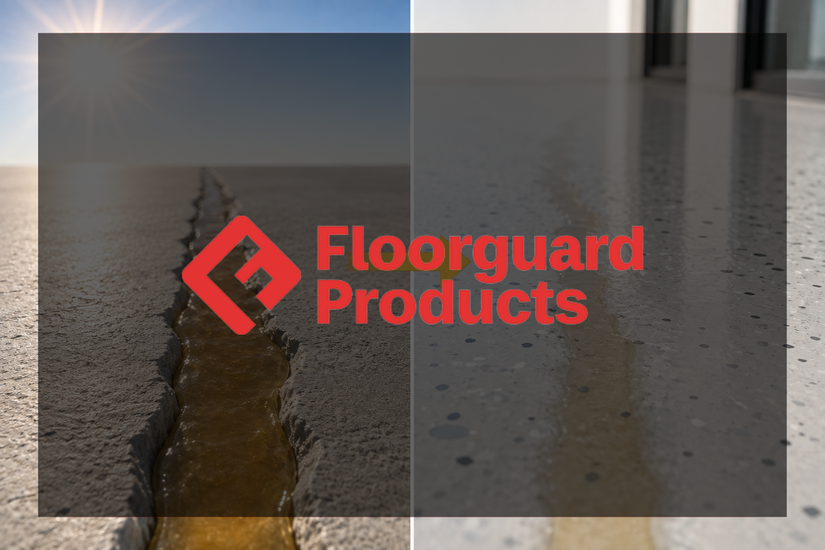
Why Polyurea Crack Repair Products Amber Under UV Exposure—and Why the Discoloration Can Shadow Through Finished Resinous Flooring
Polyurea crack-repair materials are widely used beneath resinous flooring systems because of their rapid cure, strong adhesion, toughness, and ability to accommodate limited concrete movement. One characteristic of many polyurea repair products, however, is often misunderstood in the field: the repair material may turn yellow, amber, brown, or orange after exposure to ultraviolet radiation.
This discoloration does not automatically indicate defective material, improper cure, or loss of structural performance. In many cases, it is the predictable result of the aromatic chemistry used to manufacture the polyurea. Moisture entering or migrating through a crack can further influence the appearance, and severe discoloration of a repair can sometimes remain visible—or "shadow"—through subsequently applied coatings.
This phenomenon can become especially noticeable in exterior resinous flooring systems that use a relatively thin polyurea basecoat, because the combination of direct UV exposure and lower pigmented film build can provide less optical hiding than a thicker high-build epoxy body coat.
Understanding the condition requires separating four related mechanisms:
UV-induced discoloration of the repair polymer → moisture-related effects at the crack → coating opacity and film-build limitations → optical shadowing through the finished system.
Aromatic Polyurea and UV-Induced Ambering
Not all polyureas have the same resistance to ultraviolet radiation.
Many rapid-setting polyurea crack fillers, spall-repair materials, joint fillers, and economical basecoat formulations use aromatic isocyanate chemistry. Aromatic systems are frequently selected because they provide an advantageous combination of fast reaction, toughness, adhesion, elongation, processing characteristics, and cost.
The tradeoff is reduced color stability under ultraviolet exposure.
Manufacturers of polyurea materials openly recognize this behavior. VersaFlex, for example, states that aromatic polyurea systems undergo color change when exposed to direct sunlight because of their chemical composition. The company separately markets aliphatic polyurea products specifically for improved UV weathering and color stability.
When UV radiation reaches an aromatic polyurea, photons are absorbed by susceptible portions of the cured polymer structure. That energy initiates photochemical reactions that can include free-radical formation, oxidation, molecular rearrangement, and chain degradation.
The practical sequence is:
UV radiation → energy absorption → reactive molecular species → oxidation / molecular rearrangement → formation of chromophoric structures → yellow / amber / brown discoloration.
These newly formed chromophoric structures absorb visible wavelengths differently than the original polymer. The repair therefore develops a progressively warmer and darker appearance.
The important field distinction is:
Color change does not automatically mean cure failure.
An aromatic polyurea can be correctly proportioned, properly mixed, fully cured, strongly bonded, and mechanically serviceable while still undergoing significant UV-induced discoloration.
Aromatic Versus Aliphatic Chemistry
The difference between aromatic and aliphatic chemistry is fundamental to understanding exterior performance.
Aromatic isocyanate-based materials generally provide good mechanical performance but are susceptible to yellowing, chalking, or color shift when exposed to sunlight. Aliphatic isocyanate chemistry provides substantially better resistance to this photochemical discoloration.
Sika similarly distinguishes cost-effective aromatic chemistry associated with yellowing/chalking from aliphatic chemistry intended to provide UV-stable, non-yellowing performance.
This is why many resinous flooring systems are designed with:
aromatic repair/base materials beneath the system
and
aliphatic polyaspartic, polyurethane, or polyurea chemistry as the exposed UV-resistant finish.
The UV-resistant topcoat protects the visible surface, but that does not mean every underlying layer is completely isolated from the optical effects of a strongly discolored substrate.
Why the Condition Is More Noticeable on Exterior Polyurea Basecoat Systems
This issue is often more apparent on exterior decorative flake systems, patios, walkways, pool decks, breezeways, balconies, open garages, and other installations using a polyurea basecoat than on comparable systems using a thicker high-build epoxy.
There are two primary reasons:
1. Exterior exposure provides substantially greater and more continuous UV energy.
2. Many flooring polyurea basecoats are installed at a lower film thickness than high-build epoxy body coats.
Those factors compound each other.
Exterior Exposure Increases the UV Load
An exterior floor can receive direct solar radiation for hours every day.
Repairs may be exposed before the coating system is installed, and depending upon the opacity of the completed system, some UV and visible radiation can continue interacting with underlying materials after installation.
Areas near:
- open garage doors;
- south- or west-facing exposures;
- storefront glazing;
- balcony edges;
- patio openings;
- pool decks;
- exterior walkways;
- loading docks;
- and partially covered structures
can receive substantially more ultraviolet radiation than an interior floor.
This means the aromatic crack repair can begin discoloring before the installer even applies the basecoat.
If the repair remains exposed for several days—or longer—between preparation and coating installation, a clear, off-white, or pale repair material can become visibly amber or brown.
Once that high-contrast repair is covered, the coating system must have sufficient opacity and total film build to hide it.
Polyurea Basecoats Are Often Applied Thinner Than High-Build Epoxy
This is an especially important practical difference.
In common decorative resinous-flooring systems, a polyurea basecoat may be applied at approximately 8–9 mils wet-film thickness, whereas a high-build epoxy may commonly be installed at 10–20 mils WFT, depending upon product and system design.
For example, Floorguard's Polyurea Basecoat is published at approximately 170–200 ft²/gal and 8–9 mils WFT.
By comparison, Floorguard's HyperREZ UV epoxy is published at approximately:
- 160 ft²/gal at 10 mils WFT as a thinner coat; and
- 80 ft²/gal at 20 mils WFT as a buildcoat.
Other 100% solids epoxy systems from the same manufacturer are likewise published across approximately 10–20 mils WFT.
This does not mean that every polyurea is inherently thinner than every epoxy. Polyureas can be formulated and installed at much greater thicknesses in other applications. The important distinction is the typical decorative flooring configuration being discussed: a relatively thin pigmented polyurea basecoat beneath flake versus a higher-build pigmented epoxy body coat.
That difference in film build can have a major effect on hiding power.
Why Lower Film Thickness Makes Shadowing More Likely
Pigmented coatings do not become opaque simply because pigment is present.
Hiding power depends on:
- pigment concentration;
- pigment type;
- coating color;
- refractive properties of the resin;
- wet- and dry-film thickness;
- number of pigmented coats;
- substrate contrast;
- and the color of the material beneath the coating.
A thicker pigmented film presents a longer optical path through pigment particles.
In simplified terms:
greater pigmented DFT → greater light scattering and absorption → better substrate hiding.
Conversely:
lower pigmented DFT → greater probability of substrate influence → greater potential for repair shadowing.
This becomes especially important when the substrate is no longer normal gray concrete but a dark amber or brown polyurea repair.
An 8–9 mil polyurea basecoat may provide excellent adhesion and broadcast performance while still offering less masking capacity than a 15–20 mil high-build epoxy coat of similar color.
The difference is not necessarily a deficiency in the polyurea.
It is a predictable consequence of film thickness, optical opacity, and contrast ratio.
Why the Effect Can Be More Pronounced After Flake Broadcast
A common assumption is that a full flake broadcast automatically makes the system completely opaque.
That is not always true.
Decorative flake creates substantial visual masking, but the actual system still contains:
- the pigmented basecoat;
- individual flakes;
- gaps and interfaces between flakes;
- grout or clear resin;
- and one or more clear topcoats.
Depending upon flake size, broadcast density, scraping, basecoat color, and finish system, the substrate can still influence the final appearance.
A severely ambered repair line may therefore create a subtle darker band beneath a completed full-flake system.
This can become more noticeable after the clear topcoat is installed because the topcoat changes surface reflectivity, gloss, refractive behavior, and visual depth.
Exterior Polyurea Systems Can Therefore Create a Perfect Combination for Read-Through
The field condition can be summarized as:
aromatic crack repair
- high exterior UV exposure
- repair darkening before coating
- relatively thin pigmented polyurea basecoat
- light basecoat and/or decorative flake system
=
increased potential for visible crack-repair shadowing.
By contrast, a 15–20 mil pigmented epoxy body coat places substantially more pigmented material between the observer and the repair.
That increased optical mass often provides better hiding.
This is one reason a repaired crack may disappear completely beneath a high-build epoxy installation yet remain faintly visible beneath a thinner polyurea basecoat system.
The Difference Is Optical, Not Necessarily Structural
This distinction is essential during troubleshooting.
If the crack repair is visible after coating, it does not automatically mean:
- the repair migrated through the coating;
- the polyurea attacked the basecoat;
- the basecoat failed;
- the repair was improperly cured;
- or the coating was defective.
The condition may simply be optical.
Visible light passes through the coating system, interacts with the darker repair beneath it, and returns toward the observer.
The resulting line may be described as:
shadowing, ghosting, telegraphing, or read-through.
This is fundamentally different from chemical bleed.
Optical shadowing ≠ chemical migration.
Why Light Exterior Colors Are Especially Sensitive
Exterior systems often use:
- light gray;
- beige;
- tan;
- white;
- light flake blends;
- and other colors selected to reduce heat gain.
Those colors can make repair shadowing much easier to detect.
The contrast relationship is straightforward:
dark amber repair + light coating + thin basecoat = high visual contrast.
A charcoal or dark-gray coating may hide the same repair far more effectively.
This is why the condition is not always equally visible across different colors even when the same repair material and installation procedure were used.
Moisture Intrusion Can Further Intensify the Appearance
Moisture deserves separate consideration because cracks frequently become preferential pathways for water movement.
Possible sources include:
- rainfall;
- irrigation;
- groundwater;
- elevated sub-slab moisture;
- failed or absent vapor retarders;
- hydrostatic pressure;
- washdown water;
- plumbing leakage;
- condensation;
- and water entering exposed cracks before coating installation.
The presence of moisture does not automatically mean moisture caused the ambering.
Classic yellow-to-amber discoloration of aromatic polyurea is fundamentally consistent with UV-driven chemistry.
Moisture can, however, intensify the visual condition.
Wet Concrete Appears Darker
Concrete commonly becomes visibly darker when wet.
If moisture travels preferentially through or along a repaired crack, the concrete immediately adjacent to the repair can therefore become darker than the surrounding slab.
When this lies beneath a relatively thin pigmented coating, the darker substrate can contribute to the visible line.
The apparent condition may therefore represent a combination of:
ambered polyurea + damp concrete + thin coating opacity + optical read-through.
Exterior Conditions Increase the Moisture Opportunity
Exterior applications create significantly more potential water exposure than conditioned interior floors.
Rainfall, irrigation, drainage deficiencies, slab edges, expansion joints, penetrations, and thermal cycling can all introduce moisture.
Repeated wetting and drying can make a crack line appear more or less pronounced at different times.
This is diagnostically important.
If a visible repair line changes noticeably following:
- rain;
- irrigation;
- washing;
- humidity changes;
- or prolonged dry weather,
the investigator should consider moisture involvement rather than attributing the entire condition to UV ambering.
Moisture Can Influence the Repair/Concrete Interface
Persistent water exposure can also affect the concrete surrounding a repair.
Depending upon the system and exposure, the investigator may encounter:
- localized concrete darkening;
- soluble salt deposits;
- efflorescence;
- interfacial weakening;
- coating whitening;
- blistering;
- loss of adhesion;
- or localized delamination.
These are fundamentally different from ordinary cosmetic ambering.
An intact, firmly bonded amber repair is one condition.
A discolored repair accompanied by moisture-related adhesion failure is another.
Why Another Coat May Help—but May Not Completely Solve It
Adding another pigmented coat increases hiding power.
If insufficient opacity is the primary mechanism, an additional properly applied coat can substantially reduce the visible repair.
However, another coat may not completely eliminate the condition where:
- the repair is already dark brown;
- the finish color is very light;
- the additional film is also relatively thin;
- pigment hiding power is limited;
- moisture continues darkening the substrate;
- or the system remains optically translucent.
This is why simply telling an installer to "put another coat over it" is not always a technically sufficient solution.
The underlying cause of the contrast should first be established.
Why Film-Build Verification Matters
When shadowing is observed, actual material consumption should be verified.
The correct investigation is not merely:
"Was a coat applied?"
It should evaluate:
gallons installed ÷ square footage coated = actual coverage rate
and then compare that result with the manufacturer's intended wet-film thickness.
For example, if a product intended for approximately 170–200 ft²/gal at 8–9 mils WFT is stretched substantially beyond that coverage, its effective film thickness and hiding ability will be reduced.
Likewise, an epoxy designed for approximately 10–20 mils WFT will not provide its expected hiding or build if it is spread excessively thin.
Film thickness therefore becomes both an installation-control variable and a diagnostic variable.
Diagnosing a Visible Crack-Repair Line
When a repaired crack shadows through an exterior resinous floor, the investigation should evaluate:
- Repair chemistry — aromatic versus aliphatic.
- UV exposure before coating — particularly time between repair installation and coating.
- Exterior orientation — sunlight intensity and duration.
- Repair color before coating — clear, yellow, amber, or brown.
- Basecoat chemistry — polyurea versus epoxy or another resin.
- Actual basecoat coverage rate.
- Calculated WFT and expected DFT.
- Basecoat color and pigment opacity.
- Flake broadcast density and finished system construction.
- Moisture condition at the crack.
- Evidence of active water intrusion.
- Adhesion condition.
- Whether the discoloration exists beneath the coating or within the coating itself.
- Whether crack movement remains active.
Preventing the Condition
The most effective strategy is to address the repair before the decorative system is installed.
Polyurea repair material should be:
- allowed to cure according to manufacturer requirements;
- shaved or mechanically ground flush;
- cleaned of residue;
- inspected for severe discoloration;
- and evaluated before application of light-colored, relatively thin basecoats.
Where a repair has undergone substantial UV ambering, possible preventive measures can include:
- mechanically removing the heavily discolored exposed repair surface;
- installing a sufficiently opaque compatible primer;
- using a higher-build pigmented coat where the system permits;
- ensuring the specified basecoat coverage and WFT are actually achieved;
- minimizing prolonged UV exposure between repair and coating installation;
- correcting active water intrusion;
- and installing a representative test area where extensive repairs exist beneath a light-colored exterior system.
Technical Conclusion
Ambering of polyurea crack-repair products is most commonly associated with UV exposure of aromatic polymer chemistry. Aromatic systems can remain fully cured and mechanically serviceable while undergoing pronounced yellow, amber, or brown discoloration.
The condition becomes particularly important in exterior decorative flooring systems using relatively thin polyurea basecoats.
Exterior exposure produces a greater UV dose and can substantially darken the repair before coating installation. A typical flooring polyurea basecoat may then be applied at approximately 8–9 mils WFT, while a high-build epoxy system may commonly provide 10–20 mils WFT, depending upon the particular product and system.
That difference in pigmented film build matters.
A thinner coating provides less optical masking of a high-contrast substrate. Consequently, a dark amber polyurea repair may remain faintly visible through a finished polyurea/flaked flooring system even though the basecoat, repair, and topcoat are all properly cured and bonded.
Moisture can further intensify the effect by darkening concrete along the crack, producing preferential moisture pathways, or creating separate interfacial and coating conditions.
The complete mechanism can therefore be summarized as:
aromatic repair chemistry + UV exposure + repair ambering + exterior moisture potential + relatively low pigmented film build + substrate contrast = increased probability of visible repair shadowing.
This explains why the phenomenon may be observed more frequently on exterior polyurea basecoat installations than beneath thicker high-build epoxy body coats.
The appropriate technical response is therefore not to assume product failure or chemical bleed. The repair chemistry, UV history, moisture condition, actual coverage, film thickness, coating opacity, color contrast, and completed system construction should be evaluated together before determining the cause or corrective action.