


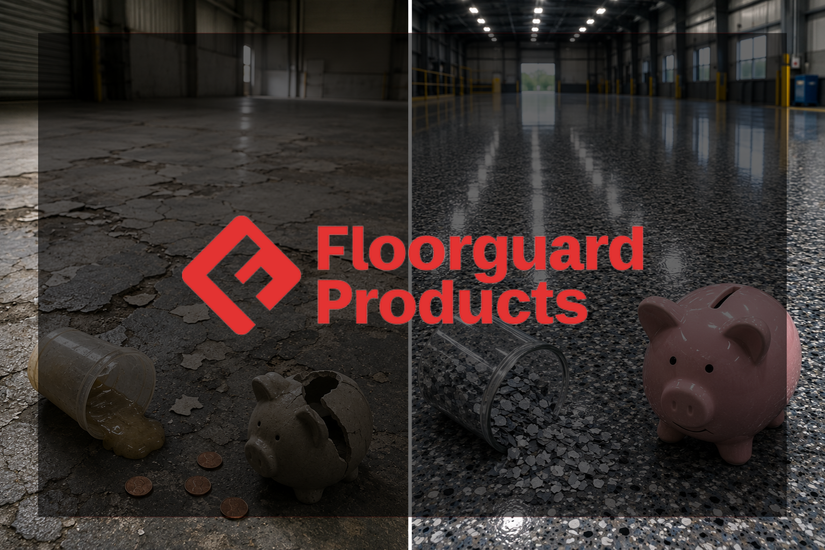
The Cheapest Resin Is Often the Most Expensive Floor
Posted by Floorguard Products on Jun 10th 2026
Why Not All Resins Are Created Equal
When evaluating resinous flooring materials, one question often dominates the conversation:
"What's the price per gallon?"
Unfortunately, that question frequently leads to the wrong decision.
While price is important, it only tells part of the story.
The reality is that two products may appear similar on paper, be marketed for the same application, and even share the same resin classification—yet perform very differently in the field.
Why?
Because not all resins are formulated equally.
Not all raw materials are equal.
Not all manufacturing standards are equal.
And not all performance claims are supported by the same level of engineering, quality control, and technical expertise.
In many cases, the least expensive resin ends up becoming the most expensive floor.
A Resin Classification Doesn't Tell the Whole Story
One of the biggest misconceptions in the flooring industry is assuming that all epoxies, polyureas, polyaspartics, or urethane cements perform similarly.
They don't.
Consider two epoxy coatings.
Both may be labeled:
"100% Solids Epoxy"
Yet one may significantly outperform the other.
The reason is simple:
The label describes the chemistry.
It doesn't describe the formulation quality.
The difference is often found in what happens behind the scenes.
The Formula Matters
Every resin system is a combination of raw materials.
These include:
- Base resins
- Hardeners
- Additives
- Pigments
- Fillers
- Performance modifiers
- Rheology agents
- UV stabilizers
- Flow agents
- Defoamers
The quality of those components directly affects performance.
Think of it like baking a cake.
Two cakes may follow the same recipe.
The one made with premium ingredients will almost always outperform the one made with the cheapest available ingredients.
The same principle applies to resinous flooring.
How Some Manufacturers Reduce Cost
Not all cost reductions are bad.
However, some lower-priced products achieve their pricing through compromises that may affect long-term performance.
Potential examples include:
- Lower-grade raw materials
- Reduced additive packages
- Increased filler loading
- Lower-cost hardeners
- Reduced UV stabilizers
- Lower-performance pigments
- Additional solvents or diluents
The material may still work.
The question becomes:
How well will it perform over time?
The Hidden Cost of Missing Additives
Many of the most important ingredients in a flooring system are never visible to the installer.
High-performance additives often improve:
- Flow and leveling
- UV resistance
- Color stability
- Chemical resistance
- Abrasion resistance
- Surface appearance
- Long-term durability
Removing or reducing these additives may lower manufacturing costs.
It can also reduce performance.
What appears to be a savings during purchase may become a cost later through:
- Shorter service life
- More maintenance
- Increased wear
- Earlier replacement
Solvents Can Create the Illusion of Value
One common method used to reduce manufacturing cost is the introduction of solvents or diluents.
At first glance, this can appear beneficial.
The material may:
- Flow easier
- Apply easier
- Feel less viscous
But there's an important consideration.
When solvents evaporate, they leave the coating film.
That means part of what was purchased never remains in the floor.
Solids Stay. Solvents Leave.
The flooring system that ultimately protects the concrete is the material that remains after cure.
Higher-quality formulations are often designed to maximize the performance characteristics of the cured film—not simply the ease of manufacturing or initial selling price.
The question isn't:
"How much material did I buy?"
The better question is:
"How much performance remains after cure?"
Cheap Material Can Become Expensive Labor
Contractors often focus heavily on material cost.
Yet labor typically represents the largest portion of project cost.
If a lower-quality resin creates:
- Reduced working time
- Inconsistent performance
- Additional application challenges
- More callbacks
- Increased repairs
The initial savings can disappear quickly.
Sometimes the cheapest material costs the most once labor and risk are considered.
The Cost of Failure Is Never in the Material
A failed floor is rarely expensive because of the coating itself.
The true costs come from:
- Shutdowns
- Lost production
- Replacement labor
- Facility disruption
- Warranty claims
- Customer dissatisfaction
Saving a few dollars per gallon becomes insignificant when compared to the cost of replacing a failed flooring system.
Why Manufacturing Matters
Resin quality isn't determined solely by raw materials.
Manufacturing consistency is equally important.
High-performance flooring systems require:
- Precise formulation control
- Consistent batching
- Quality testing
- Process verification
- Raw material traceability
The ability to consistently reproduce the same product batch after batch is critical to long-term performance.
The Advantages of U.S.-Manufactured Resin Systems
While quality products can be manufactured globally, many contractors, distributors, and facility owners prefer U.S.-manufactured resin systems for several reasons.
Greater Quality Control
Domestic manufacturing often allows for:
- Tighter production oversight
- More consistent quality verification
- Better batch control
- Improved traceability
Consistency is one of the most important aspects of flooring performance.
A coating that performs exceptionally one month should perform the same six months later.
Faster Technical Support
When products are manufactured domestically, technical teams are often closer to:
- Production facilities
- Quality control departments
- Research and development teams
This can improve response times when technical questions or field issues arise.
Better Supply Chain Reliability
Recent years have highlighted the importance of supply chain stability.
Domestic manufacturing often helps reduce risks associated with:
- Shipping delays
- Import restrictions
- International logistics disruptions
- Raw material sourcing uncertainties
For contractors and distributors, availability matters.
Research and Development Drives Performance
Many premium manufacturers invest heavily in:
- Product development
- Laboratory testing
- Field validation
- Technical training
- Continuous improvement
These investments often result in better-performing products—but they also increase manufacturing costs.
That investment frequently shows up as better long-term performance in the field.
Not All Resins Are Equal
This is perhaps the most important takeaway.
Two products may share the same resin classification.
That does not mean they share the same performance characteristics.
The differences often come down to:
- Raw material quality
- Additive technology
- Formulation expertise
- Manufacturing consistency
- Quality control
- Technical support
The chemistry category tells part of the story.
The formulation tells the rest.
The Better Question to Ask
Instead of asking:
"What's the cheapest product?"
Ask:
"What's the total lifecycle cost?"
That question changes the conversation.
A coating that lasts twice as long, requires less maintenance, and reduces risk often becomes the more economical solution—even if the initial purchase price is higher.
Bottom Line
In resinous flooring, price and value are not the same thing.
Lower-cost resins may achieve their pricing through lower-grade raw materials, reduced additive packages, increased fillers, or solvent-heavy formulations.
Premium formulations often incorporate higher-quality components, enhanced performance additives, stricter quality control, and greater manufacturing consistency.
The result is frequently:
- Better durability
- Better appearance retention
- Better chemical resistance
- Better long-term performance
- Lower lifecycle cost
Because when it comes to flooring, the cheapest gallon isn't always the cheapest floor.
And the true cost of a resin isn't measured on installation day.
It's measured years later by how well the floor is still performing.