


Surface Preparation: The Most Important Step Nobody Sees
Posted by Floorguard Products on Jun 10th 2026
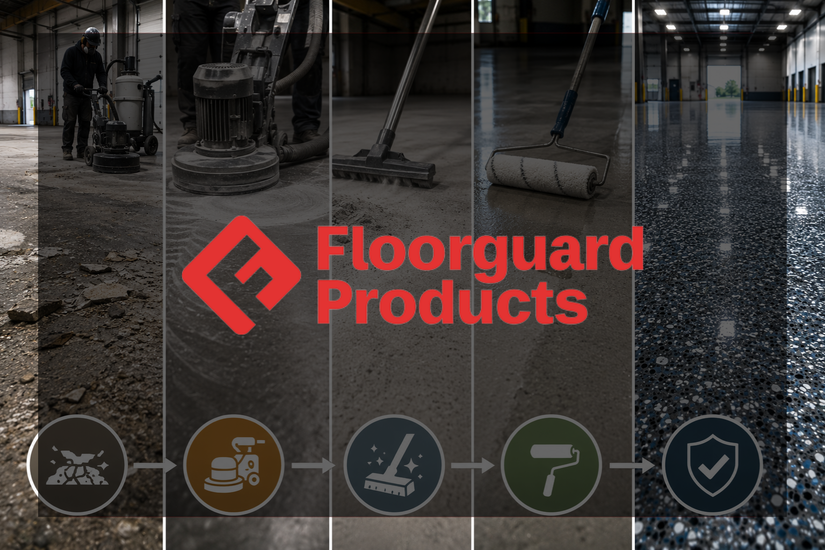
Why Great Floors Fail Before the Coating Ever Hits the Concrete
Ask a flooring contractor what causes most coating failures, and you'll often hear answers like:
- Moisture
- Product selection
- Installation errors
- Environmental conditions
While all of those can contribute to failure, one issue consistently sits at the top of the list:
Inadequate Surface Preparation
The reality is simple:
A coating system is only as good as the surface beneath it.
You can install the most expensive epoxy, polyaspartic, polyurea, or urethane cement system available. If the concrete isn't properly prepared, failure is only a matter of time.
Surface Preparation Creates the Bond
Many people think coatings stick because they're "sticky."
They don't.
Resinous flooring systems achieve their strength through mechanical adhesion.
The coating flows into the microscopic peaks, valleys, and pores created during surface preparation. Once cured, the coating becomes mechanically locked into the concrete.
No profile = No bond.
It's that simple.
What Happens When Surface Preparation Is Skipped?
Improperly prepared concrete may initially look acceptable.
The problems usually show up weeks, months, or years later.
Common failures include:
⚠️ Delamination
⚠️ Peeling
⚠️ Blistering
⚠️ Edge lifting
⚠️ Tire pickup
⚠️ Premature wear
⚠️ Reduced service life
When these failures occur, the coating is often blamed.
In reality, the coating may have never had a chance to properly bond in the first place.
Surface Preparation Does More Than Create Profile
Many installers focus solely on roughening the surface.
While profile is important, preparation serves several critical functions:
Removes Surface Contaminants
Concrete can contain:
- Oil
- Grease
- Wax
- Sealers
- Curing compounds
- Paint
- Adhesive residue
- Dust and debris
Any material left between the coating and concrete becomes a weak link in the system.
Opens the Concrete Surface
Proper preparation exposes sound concrete and allows primers and coatings to penetrate the substrate.
This creates stronger mechanical adhesion and improves overall system performance.
Reveals Hidden Problems
Preparation often uncovers issues that would otherwise remain hidden:
- Cracks
- Spalls
- Delaminated concrete
- Surface laitance
- Previous repairs
- Contamination
Identifying these problems early allows them to be properly repaired before coating installation begins.
Not All Preparation Methods Are Equal
One of the biggest misconceptions in the industry is that all preparation methods produce the same result.
They don't.
Different flooring systems require different concrete surface profiles.
Diamond Grinding
Diamond grinding is one of the most common preparation methods used in resinous flooring.
Best For:
- Thin-film coatings
- Primers
- Grind-and-seal systems
- Flake Systems
- Quartz Systems
Advantages:
- Smooth, uniform profile
- Minimal surface damage
- Excellent dust control when properly vacuumed
Diamond grinding is effective, but it may not provide enough profile for thicker or heavy-duty systems.
Shot Blasting
Shot blasting is often considered the gold standard for many industrial flooring applications.
Best For:
- Heavy-build coatings
- Industrial flooring
Advantages:
- Consistent profile
- Removes contaminants
- Opens concrete pores effectively
- Produces excellent mechanical bond
Shot blasting creates a deeper, more aggressive profile than grinding and is often preferred for thicker resinous systems.
Scarifying
Scarifying uses rotating cutters to aggressively remove concrete.
Best For:
- Thick coating removal
- Surface correction
- Heavy contamination
- Severe surface deterioration
Advantages:
- Rapid material removal
- Deep profile creation
- Effective for heavily damaged substrates
Because scarifying is aggressive, additional grinding is often required afterward to refine the surface.
Understanding CSP Profiles
The International Concrete Repair Institute (ICRI) developed Concrete Surface Profile (CSP) standards to help match preparation methods with flooring systems.
Think of CSP numbers as a roughness scale.
Lower Numbers
CSP 1-2
Smooth profile
Typical for:
- Sealers
- Grind-and-seal systems
Medium Profiles
CSP 3-4
Moderate profile
Typical for:
- Epoxy coatings
- Flake systems
- Quartz systems
Higher Profiles
CSP 4-5+
Aggressive profile
Typical for:
- Moisture Vapor Primers
- Urethane cement
- Heavy industrial systems
- Thick resurfacing applications
The goal isn't to create the roughest surface possible.
The goal is to create the correct surface profile for the system being installed.
The Most Overlooked Step: Vacuuming
A perfectly prepared floor can still fail if dust is left behind.
Concrete dust acts as a bond breaker.
After preparation:
- Vacuum thoroughly
- Vacuum again
- Inspect the surface
- Remove all residual dust
Many experienced installers will tell you:
"The vacuum is just as important as the grinder."
They're right.
Surface Preparation Is Not the Place to Save Money
Owners sometimes question the cost of preparation.
Contractors sometimes feel pressure to reduce preparation time.
Both decisions can become expensive.
A failed coating system can cost many times more than proper preparation.
The preparation phase is where flooring performance is earned.
Everything after that simply builds on the foundation created by the prep work.
A Simple Rule to Remember
When evaluating a flooring failure, ask one question:
"Would this coating still have failed if the surface preparation had been perfect?"
In many cases, the answer is no.
Bottom Line
Surface preparation isn't the first step of a flooring installation.
It's the foundation of the entire system.
Proper preparation:
- Creates mechanical adhesion
- Removes contaminants
- Exposes sound concrete
- Reveals hidden defects
- Maximizes coating performance
- Extends service life
- Reduces callbacks and failures
The coatings get the attention.
The finished floor gets the compliments.
But surface preparation is where successful flooring systems are truly built.