


Epoxy vs. Polyurea vs. Polyaspartic
Posted by Floorguard Products on Jun 10th 2026
Understanding the Strengths, Limitations, and Best Uses of Today's Most Common Resin Technologies
Walk into any resinous flooring discussion and you'll hear the same debate:
"Which is better—epoxy, polyurea, or polyaspartic?"
The answer is simple:
None of them.
At least not by themselves.
Each resin technology was developed to solve different performance challenges. The real question isn't which resin is best.
The real question is:
Which resin is best for the environment, conditions, and performance requirements of the project?
Understanding how these chemistries differ is one of the most important factors in selecting the right flooring system.
First, Let's Clear Up a Common Misconception
Many people assume resinous flooring systems are made entirely from one resin type.
In reality, most high-performance flooring systems combine multiple resin technologies.
For example:
- Epoxy primer
- Polyurea basecoat
- Polyaspartic topcoat
Or:
- Epoxy moisture mitigation primer
- Epoxy body coat
- Polyaspartic finish coat
Modern flooring systems are often designed to leverage the strengths of multiple resin chemistries rather than relying on a single material throughout the entire system.
Epoxy
The Foundation of the Resinous Flooring Industry
Epoxy has been the backbone of industrial flooring for decades.
It remains one of the most widely used resin technologies because of its versatility, strength, and excellent adhesion characteristics.
What Epoxy Does Best
- Exceptional adhesion
- High compressive strength
- Excellent bond to concrete
- Strong chemical resistance
- Excellent build thickness
- Cost-effective performance
Epoxy excels as a primer, body coat, and structural layer within many flooring systems.
Where Epoxy Struggles
Like every resin technology, epoxy has limitations.
Common Challenges
- UV sensitive
- Can amber or yellow over time
- Lower flexibility
- Slower cure speeds
- Reduced low-temperature performance
For interior industrial environments, these limitations are often insignificant.
For exterior or UV-exposed applications, they can become concerns.
Think of Epoxy As...
The Strength Layer
When compressive strength, adhesion, and structural performance are required, epoxy is often the first choice.
Polyurea
Built for Speed and Flexibility
Polyurea was originally developed for applications requiring rapid cure and greater flexibility than traditional epoxy systems.
Compared to epoxy, polyurea cures significantly faster and offers much higher elongation characteristics.
What Polyurea Does Best
- Fast cure
- High elongation
- Excellent crack-bridging ability
- Good impact resistance
- Cold-temperature installation capability
- Reduced downtime
Polyurea systems are commonly selected when speed and flexibility are critical.
Where Polyurea Struggles
Common Challenges
- Limited working time
- More difficult installation
- Poor UV resistance
- Sensitive to application conditions
- Requires experienced installers
Because of its rapid reaction speed, polyurea leaves little room for installation errors.
What takes epoxy 30–40 minutes may occur in minutes with polyurea.
Think of Polyurea As...
The Flexibility Layer
When movement, impact, crack resistance, and fast return-to-service are priorities, polyurea often becomes the preferred solution.
Polyaspartic
The Performance Topcoat
Polyaspartic technology emerged as a way to improve upon some of the challenges associated with traditional polyurea coatings.
Today, polyaspartics have become one of the most popular topcoat technologies in decorative and industrial flooring systems.
What Polyaspartic Does Best
- UV stability
- Color retention
- Excellent abrasion resistance
- Excellent chemical resistance
- Fast return-to-service
- High gloss retention
- Exterior performance
Polyaspartics are frequently selected as the wear surface of the system.
Where Polyaspartics Struggle
Common Challenges
- Higher material cost
- Shorter working time than epoxy
- More temperature-sensitive application
- Can become difficult to manage in hot conditions
Although polyaspartics cure more slowly than traditional polyureas, they still require installers to work efficiently and understand environmental influences.
Think of Polyaspartic As...
The Protection Layer
When appearance, UV stability, abrasion resistance, and long-term durability matter, polyaspartics are often the finishing layer of choice.
Comparing the Three Resin Technologies
The Biggest Mistake in Resin Selection
One of the most common mistakes in flooring design is assuming a single resin technology is ideal for every environment.
For example:
A manufacturer may choose epoxy because it offers excellent strength.
But if the floor receives direct sunlight, yellowing becomes an issue.
Another project may specify polyaspartic because of its UV stability.
But the floor may require greater crack-bridging performance than the polyaspartic can provide.
A food processing facility may prioritize flexibility.
Yet chemical exposure may demand a different chemistry entirely.
Every environment introduces different stressors.
The Best Systems Combine Resin Technologies
This is why many modern flooring systems use hybrid resin designs.
Examples include:
Epoxy + Polyaspartic
Strong foundation with UV-stable protection.
Polyurea + Polyaspartic
Fast installation with superior wear resistance.
Epoxy + Polyurea + Polyaspartic
Structural strength, flexibility, and UV stability combined into a single system.
Rather than asking:
"Which resin is best?"
The better question is:
"Which combination of resins delivers the performance this environment requires?"
Match the Resin to the Challenge
Heavy Industrial Manufacturing
Often favors epoxy for strength and durability.
Fast-Track Commercial Projects
Often favor polyurea or polyaspartic for reduced downtime.
Exterior Applications
Often require polyaspartic UV stability.
Cracked or Moving Substrates
Often benefit from polyurea flexibility or flexible epoxy formulation.
Decorative Systems
Frequently combine epoxy build layers with polyaspartic finish coats.
Bottom Line
Epoxy, polyurea, and polyaspartic are not competing technologies.
They are complementary technologies.
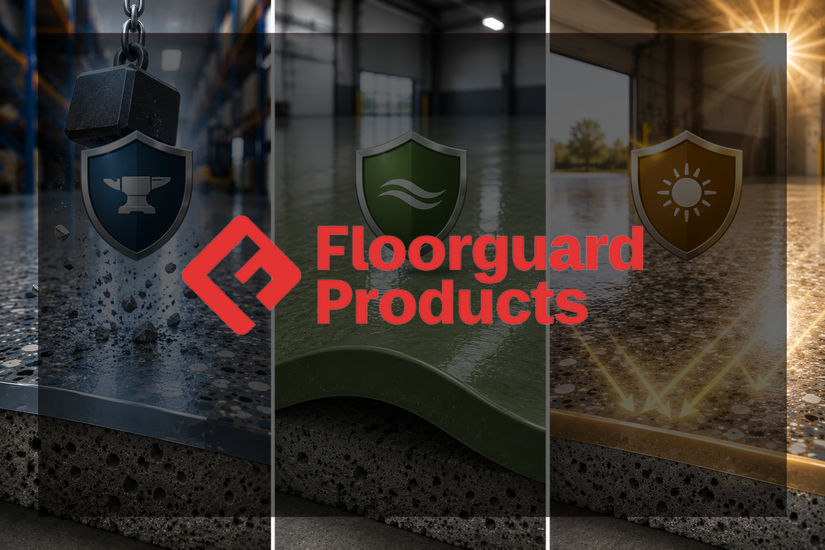
Epoxy delivers strength and adhesion.
Polyurea delivers flexibility and speed.
Polyaspartic delivers UV stability and long-term protection.
The most successful flooring systems aren't built around a single resin.
They're built around selecting the right chemistry—or combination of chemistries—for the specific demands of the environment.
Because in resinous flooring, performance isn't determined by the resin you choose.
It's determined by how well that resin matches the challenges the floor will face.