


Dry Time vs. Cure Time: Why They're Not the Same Thing
Posted by Floorguard Products on Jun 10th 2026
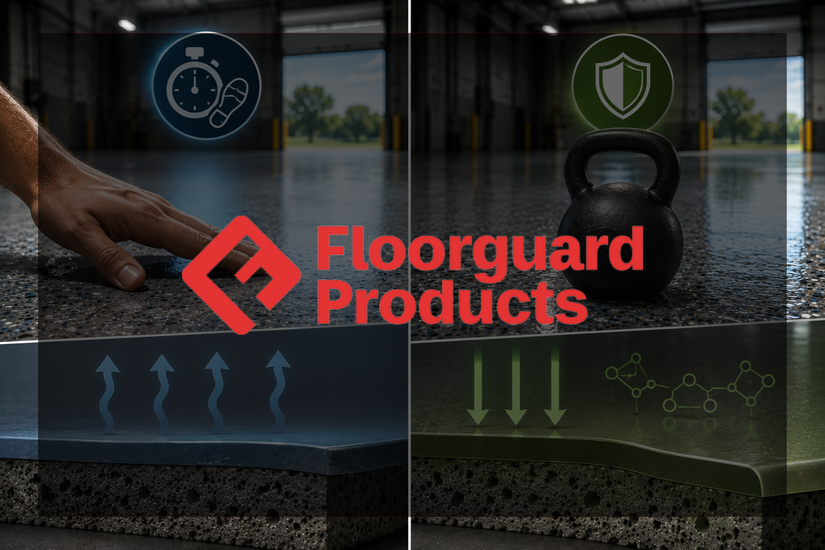
One of the Most Costly Misunderstandings in Resinous Flooring
A contractor finishes installing a floor on Friday afternoon.
Saturday morning the coating feels hard.
By Monday, forklifts are running across it.
A few weeks later:
⚠️ Tire marks appear
⚠️ Scratches develop
⚠️ Chemical staining occurs
⚠️ Surface damage begins showing up unexpectedly
The immediate assumption is often:
"The coating failed."
In many cases, the coating didn't fail at all.
It simply wasn't fully cured.
One of the most misunderstood concepts in resinous flooring is the difference between dry time and cure time.
The two terms are often used interchangeably.
They shouldn't be.
Because they represent completely different stages of coating performance.
Just Because It's Hard Doesn't Mean It's Ready
Most resinous coatings go through several stages after application.
Wet
The coating has been applied and remains fluid.
Tack-Free
The surface no longer feels sticky.
Dry to Touch
The coating feels firm enough to touch without leaving a mark.
Walk-On
Light foot traffic may be acceptable.
Return to Service
The floor can begin handling intended traffic.
Full Cure
The coating reaches its designed physical and chemical properties.
Many failures occur when people confuse one stage with another.
What Is Dry Time?
Dry time simply means the coating surface has hardened enough that it no longer feels wet.
In other words:
The coating looks finished.
But the chemistry isn't finished.
Dry time is primarily a surface condition.
It does not mean the coating has reached:
- Full hardness
- Full chemical resistance
- Full abrasion resistance
- Full adhesion strength
- Full impact resistance
The coating may look ready.
It may not be ready.
What Is Cure Time?
Cure time is the period required for the resin system to complete its chemical crosslinking process.
This is where the coating develops the performance characteristics it was designed to provide.
During cure, the coating continues building:
- Hardness
- Chemical resistance
- Abrasion resistance
- Impact resistance
- Adhesion strength
- Overall durability
The floor is still changing even after it feels hard.
Think of It Like Concrete
Fresh concrete becomes hard enough to walk on fairly quickly.
Nobody would argue that concrete reaches full strength overnight.
The same principle applies to resinous flooring.
The coating may become usable long before it becomes fully cured.
Why Cure Matters
Every performance characteristic people expect from a floor develops during cure.
Chemical Resistance
A coating may resist water after one day.
It may require several more days to achieve full resistance to acids, solvents, oils, and aggressive chemicals.
Abrasion Resistance
The floor may feel hard.
It may still be developing wear resistance.
Impact Resistance
Crosslinking continues long after the surface becomes dry.
Adhesion Strength
Bond performance often continues improving as the coating reaches full cure.
This is why manufacturers typically publish separate values for:
- Dry time
- Recoat time
- Foot traffic
- Vehicle traffic
- Full cure
They are not the same thing.
Climate Conditions Control Cure Speed
One of the biggest mistakes installers make is assuming cure schedules are fixed.
They're not.
Just like recoat windows, cure times are heavily influenced by environmental conditions.
Cold Temperatures Slow Cure
At lower temperatures:
- Chemical reactions slow
- Crosslinking slows
- Hardness develops more slowly
- Chemical resistance develops more slowly
A coating expected to reach full cure in 5-7 days at 72°F may require significantly longer at 55°F.
The floor may feel hard.
The chemistry may still be incomplete.
Hot Temperatures Accelerate Cure
As temperatures rise:
- Reaction rates increase
- Crosslinking accelerates
- Cure progresses faster
The same coating may reach service readiness much sooner in warmer conditions.
However, faster isn't always better.
Rapid curing can introduce other installation challenges including reduced working time and shortened recoat windows.
Humidity Matters Too
Humidity influences many resin technologies.
Depending on the chemistry involved, changes in humidity can affect:
- Cure progression
- Surface characteristics
- Hardness development
- Recoat timing
This is why environmental conditions should always be monitored—not assumed.
Different Resin Technologies Cure Differently
Not all coatings follow the same timeline.
Epoxy
Typically develops strength gradually over several days.
Excellent long-term performance but often slower curing.
Polyurea
Very rapid cure profile.
Can reach service conditions quickly.
Polyaspartic
Fast return-to-service characteristics while continuing to develop final performance properties after installation.
Urethane Cement
Can often tolerate service sooner than many traditional systems while still progressing toward full cure.
Each chemistry follows its own cure curve.
Return to Service Does Not Mean Fully Cured
This is another common misconception.
A technical data sheet may state:
Vehicle Traffic:
24 Hours
That does not necessarily mean:
Full Cure:
24 Hours
Manufacturers often publish separate timelines because the coating can safely handle traffic before it reaches full chemical and physical maturity.
Think of return-to-service as:
"Safe to use."
Not:
"Finished curing."
The Most Common Mistake
Many flooring failures occur because the floor is exposed to its harshest conditions too early.
Examples include:
⚠️ Chemical washdowns
⚠️ Forklift traffic
⚠️ Steel wheel traffic
⚠️ Heavy point loading
⚠️ Aggressive cleaning
⚠️ Process equipment installation
The coating may appear ready.
The chemistry may still be developing.
Why Patience Pays
Every coating manufacturer spends considerable effort determining cure schedules.
Those recommendations aren't arbitrary.
They're designed to ensure the floor reaches the performance levels the owner expects.
Giving a coating adequate cure time often means:
- Better chemical resistance
- Better abrasion resistance
- Better impact resistance
- Better long-term durability
- Fewer callbacks
- Longer service life
A Simple Rule to Remember
Dry means the surface has hardened.
Cure means the chemistry has finished developing.
Those are two very different things.
One describes appearance.
The other determines performance.
Bottom Line
In resinous flooring, dry time and cure time are not interchangeable terms.
A floor may be:
- Dry
- Hard
- Walkable
- Ready for light traffic
And still not be fully cured.
Understanding the difference helps contractors, facility owners, and project managers make better decisions regarding recoat schedules, return-to-service timelines, and long-term floor performance.
Because when it comes to resinous flooring:
Just because it feels finished doesn't mean the chemistry is finished.
And the chemistry is what ultimately determines how the floor performs for years to come.