


Moisture Testing Isn't Optional — It's Risk Management
Posted by Floorguard Products on Jun 10th 2026
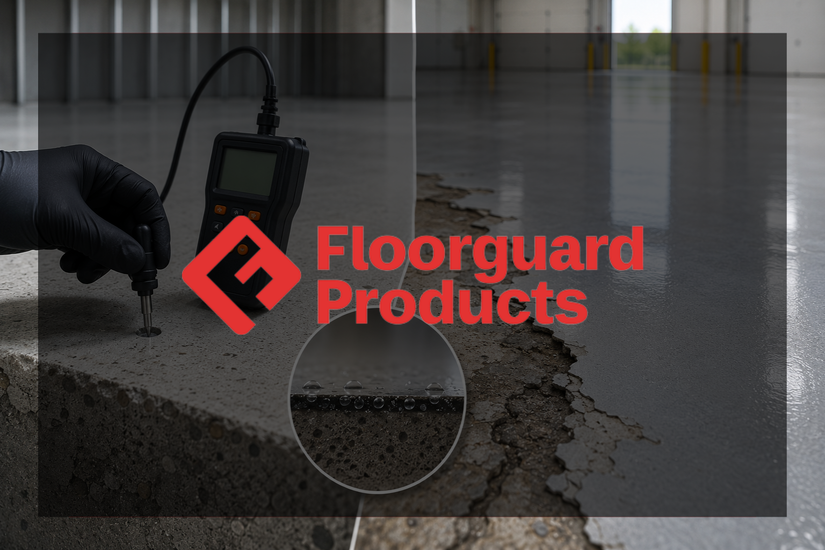
Why Moisture Testing Matters Before Installing Resinous Flooring
You can install the highest-performing coating system available, follow every mixing ratio, maintain perfect environmental conditions, and execute a flawless installation.
If excessive moisture is present in the concrete slab, none of that may matter.
Moisture-related failures remain one of the leading causes of resinous flooring problems, including:
⚠️ Blistering
⚠️ Delamination
⚠️ Bond loss
⚠️ Osmotic pressure failures
⚠️ Efflorescence
⚠️ Flooring adhesive failures
⚠️ Costly callbacks and warranty claims
The challenge is that moisture is often invisible. A slab can appear dry while still containing enough moisture to compromise a flooring system after installation.
That's why moisture testing should never be viewed as a formality—it is a critical risk assessment step.
The Three Most Common ASTM Moisture Tests
Not all moisture tests measure the same thing.
Think of them as three different ways to evaluate the same slab:
ASTM F2659
"Where are the moisture problems?"
A rapid, non-destructive screening method.
ASTM F1869
"How much moisture is leaving the slab right now?"
Measures surface moisture vapor emissions.
ASTM F2170
"How much moisture is still trapped inside the slab?"
Measures internal slab moisture conditions.
Each provides valuable information—but they are not interchangeable.
ASTM F2659
The Moisture Mapping Tool
Before drilling holes or setting calcium chloride kits, many contractors start with ASTM F2659.
Using an electronic concrete moisture meter, installers can quickly scan large floor areas and identify moisture hotspots.
Why It Matters
- Fast
- Non-destructive
- Immediate results
- Ideal for locating test areas
- No waiting period
What It Doesn't Do
ASTM F2659 does not directly measure moisture vapor emission rates or internal relative humidity.
Instead, it helps answer one simple question:
"Where should I perform additional testing?"
Think of ASTM F2659 as the slab's moisture map.
ASTM F1869
The Surface Moisture Test
ASTM F1869 is commonly known as the Calcium Chloride Test.
This method measures the amount of moisture vapor leaving the concrete surface over a 60–72 hour period.
How It Works
- Prepare the concrete surface.
- Place a pre-weighed calcium chloride dish on the slab.
- Seal it beneath a test dome.
- Allow moisture vapor to be absorbed.
- Reweigh the dish.
- Calculate the Moisture Vapor Emission Rate (MVER).
Results Are Reported As:
lbs / 1,000 sq ft / 24 hours
What F1869 Tells You
The test answers:
"How much moisture is escaping from the slab surface today?"
Advantages
- Industry recognized
- Relatively inexpensive
- Simple procedure
- Widely specified
Limitations
Because it evaluates surface conditions, results can be influenced by:
- HVAC operation
- Ambient humidity
- Temperature fluctuations
- Surface preparation
- Recent weather conditions
In other words:
F1869 measures current moisture activity—not necessarily future moisture conditions.
ASTM F2170
The Industry's Most Predictive Moisture Test
While ASTM F1869 evaluates the slab surface, ASTM F2170 looks deeper.
This method measures the internal relative humidity (RH) of the concrete slab using probes installed below the surface.
Why This Matters
When a flooring system is installed, the slab surface becomes sealed.
Moisture deeper within the slab begins moving upward until equilibrium is reached.
That means the moisture condition after installation may be very different than the condition measured at the surface before installation.
What F2170 Tells You
The test answers:
"How much moisture is still stored inside the concrete?"
Advantages
- Most predictive method available
- Measures internal moisture conditions
- Less affected by environmental changes
- Strong correlation to long-term flooring performance
- Preferred by many manufacturers
Typical Acceptance Limits
Common specification limits include:
- 75% RH
- 80% RH
- 85% RH
- 90% RH
- 95% RH
Always verify the acceptable limit with the flooring system manufacturer.
F1869 vs. F2170
Which Test Is Better?
The answer depends on what you're trying to learn.
Question
Best Test
Where are the wet areas?
ASTM F2659
How much moisture is leaving the surface today?
ASTM F1869
How much moisture remains in the slab?
ASTM F2170
Which best predicts future performance?
ASTM F2170
Most flooring manufacturers and industry experts consider ASTM F2170 the most reliable indicator of long-term slab moisture conditions because it measures the moisture reservoir that remains inside the concrete.
A Practical Testing Strategy
For most resinous flooring projects, the best approach is not choosing one test over another.
It's using them together.
Step 1
Scan the Slab
Use ASTM F2659 to identify moisture hotspots and establish test locations.
Step 2
Measure Internal Moisture
Use ASTM F2170 to determine slab readiness and verify manufacturer requirements.
Step 3
Verify Surface Emissions
Use ASTM F1869 when required by project specifications or manufacturer guidelines.
The Cost of Skipping Moisture Testing
Moisture mitigation systems cost money.
Testing takes time.
But both are insignificant compared to the cost of a failed floor.
A few hours spent testing can prevent:
❌ Delamination
❌ Blistering
❌ Flooring replacement
❌ Production downtime
❌ Warranty disputes
❌ Reputation damage
The most expensive moisture test is the one that wasn't performed.
Bottom Line
Concrete doesn't stop releasing moisture simply because it looks dry.
ASTM F2659 helps locate potential problem areas.
ASTM F1869 measures moisture vapor emissions at the slab surface.
ASTM F2170 measures the internal moisture conditions most likely to impact long-term flooring performance.
Understanding what each test measures—and when to use it—allows contractors, architects, and facility owners to make informed decisions, reduce risk, and install flooring systems with confidence.