


Moisture Vapor Primers: Why Following the Specification Matters
Posted by Floorguard Products on Jun 10th 2026
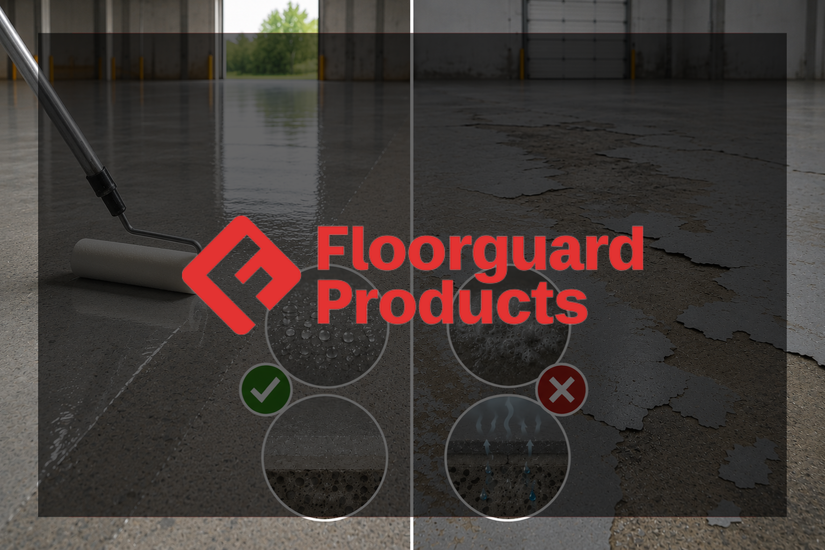
The Most Expensive Moisture Mitigation Failure Is Often Self-Inflicted
A moisture vapor primer is designed to do one job:
Control moisture vapor transmission from the concrete slab.
Sounds simple enough.
Yet many moisture mitigation systems fail not because the product was defective, but because the material was modified, stretched, or installed outside of its tested and approved parameters.
Installers may add pigment for appearance.
They may thin the material to improve flow.
They may broadcast aggregate to create texture.
Or they may simply try to get a few more square feet per gallon.
The problem?
Every one of those decisions can alter the performance of the moisture vapor primer.
And when it comes to moisture mitigation, performance isn't determined by how the floor looks.
It's determined by how effectively the primer controls moisture vapor transmission.
Moisture Vapor Primers Are Engineered Systems
Many contractors view moisture vapor primers as simply another epoxy coating.
They're not.
Moisture mitigation primers are highly engineered barrier systems designed and tested to achieve specific permeability characteristics.
Their performance is validated through laboratory testing at:
- Specific film thicknesses
- Specific application rates
- Specific resin-to-hardener ratios
- Specific formulations
The published coverage rate isn't a suggestion.
It's the thickness at which the system was tested and proven to perform.
The Goal Is Permeability Control
Moisture mitigation systems work by reducing the amount of moisture vapor capable of passing through the coating film.
Think of the primer as a traffic controller.
The denser and more continuous the film, the more effectively it restricts moisture movement.
The moment that film thickness changes, permeability changes.
And that can directly impact system performance.
Coverage Rate Equals Performance
One of the most common mistakes in the field is overextending a moisture vapor primer.
A contractor may think:
"It's only a few hundred extra square feet."
Unfortunately, moisture vapor doesn't care about material budgets.
Why Thickness Matters
Every moisture vapor primer is tested at a specific dry film thickness (DFT).
That thickness directly influences:
- Moisture resistance
- Permeability
- Pinhole resistance
- Film continuity
- Long-term performance
When the material is spread beyond its specified coverage rate:
- Film thickness decreases
- Permeability increases
- Moisture resistance decreases
- Risk of failure increases
The system being installed may no longer be the same system that was tested.
The Danger of Adding Pigment
Many installers prefer a colored primer because it provides visual coverage confirmation.
While understandable, adding pigment introduces variables that may alter the coating's performance.
What Pigments Can Do
Pigments occupy space within the coating matrix.
Depending on the type and loading level, they can:
- Alter film density
- Affect resin-to-solids ratios
- Change viscosity
- Influence cure characteristics
- Affect permeability performance
The issue isn't whether pigment is always harmful.
The issue is that the moisture mitigation system was typically not tested with that pigment package.
Once the formulation changes, the performance characteristics may change as well.
The Problem With Adding Solvents or Diluents
Some installers attempt to improve flow or workability by introducing solvents or diluents.
This may make application easier.
It can also compromise the moisture barrier.
What Happens When You Thin a Moisture Primer?
Adding solvents can:
- Reduce film build
- Increase shrinkage
- Create additional porosity
- Alter cure characteristics
- Increase permeability
In extreme cases, the resulting film may contain microscopic pathways that allow moisture vapor to migrate through the system.
The coating may still look perfectly acceptable.
The moisture resistance may not be.
Why Broadcast Aggregate Can Be a Problem
This is one of the most misunderstood practices in the industry.
Many contractors are accustomed to broadcasting aggregate into primers to improve adhesion between coats.
With standard primers, this is often acceptable.
With moisture vapor primers, the conversation becomes much different.
Moisture Barriers Need Continuity
A moisture mitigation primer works best when it forms a continuous, uninterrupted barrier.
Heavy aggregate broadcasting can introduce challenges including:
- Film displacement
- Reduced barrier continuity
- Surface disruptions
- Increased risk of voids around aggregate particles
While some manufacturers specifically allow aggregate broadcasting under certain conditions, others prohibit it entirely.
The manufacturer's installation instructions should always govern.
A Moisture Primer Is Not a Build Coat
Another common mistake occurs when installers treat moisture primers like traditional epoxy body coats.
They are fundamentally different products.
A build coat is often designed to:
- Build thickness
- Fill profile
- Receive aggregate
- Create aesthetics
A moisture vapor primer is designed to:
Control vapor transmission.
Everything else is secondary.
What the Laboratory Tested Is What Should Be Installed
When a manufacturer publishes moisture mitigation performance, those values are typically based on testing performed at specific conditions.
That testing may include:
- Film thickness
- Coverage rate
- Mixing ratios
- Cure conditions
- Moisture exposure levels
The published results apply to the tested system.
Not a modified version of the system.
Not a pigmented version.
Not a diluted version.
Not a version installed at half the specified thickness.
The tested system is the system that should be installed.
Common Reasons Moisture Mitigation Systems Fail
Many failures can be traced to one or more of the following:
⚠️ Excessive spread rates
⚠️ Inadequate film thickness
⚠️ Pinholes and holidays
⚠️ Improper surface preparation
⚠️ Moisture levels exceeding system limitations
⚠️ Unauthorized additives
⚠️ Improper mixing
⚠️ Installation outside manufacturer guidelines
In many cases, the material itself performed exactly as designed.
The installation simply no longer matched the tested system.
The Cost of Stretching Material
Trying to gain a few extra square feet of coverage can appear beneficial during installation.
Until the floor fails.
The cost of replacing a failed flooring system can exceed the cost of the original moisture mitigation system many times over.
What seems like a savings on installation day can become a major liability later.
A Simple Rule to Remember
When installing a moisture vapor primer:
Don't change the formula.
Don't thin the material.
Don't stretch the coverage rate.
Don't assume aggregate is acceptable.
Install the system exactly as it was designed and tested.
Bottom Line
Moisture vapor primers are performance products—not appearance products.
Their ability to control moisture transmission depends on:
- Proper surface preparation
- Correct mixing ratios
- Approved installation procedures
- Specified film thickness
- Published coverage rates
- Manufacturer-approved application methods
The moisture mitigation system you install should be the same moisture mitigation system that was tested.
Because when it comes to controlling moisture vapor transmission, even small changes can have a significant impact on permeability and long-term flooring performance.
The specification isn't there to make installation harder.
It's there to ensure the moisture barrier performs exactly as intended.