


Recoat Windows: Why the Clock Is Controlled by Climate, Not the Technical Data Sheet
Posted by Floorguard Products on Jun 10th 2026
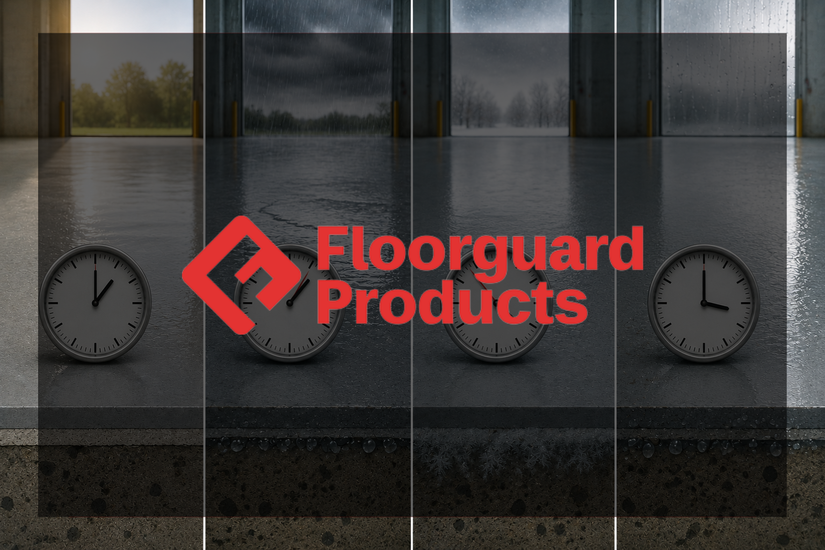
One of the Most Misunderstood Concepts in Resinous Flooring
Ask an installer when the next coat can be applied and you'll often hear:
"The TDS says 12-24 hours."
While that answer sounds reasonable, it is often incomplete.
Because recoat windows are not driven by the calendar.
They're driven by chemistry.
And chemistry is driven by environmental conditions.
Temperature, humidity, slab temperature, airflow, and resin technology all influence how quickly a coating cures and how long the surface remains receptive to the next layer.
The reality is simple:
A coating installed at 55°F does not behave the same as a coating installed at 72°F.
A coating installed at 95°F definitely does not behave the same as one installed at 72°F.
Understanding recoat windows—and what affects them—is critical to preventing intercoat adhesion failures, delamination, and costly callbacks.
What Is a Recoat Window?
A recoat window is the period during which one coating layer can be applied over another and achieve proper adhesion without additional surface preparation.
During this window, the cured coating surface remains chemically receptive to the next layer.
This allows the new coating to bond effectively with the underlying layer.
Once that window closes, the coating surface becomes increasingly resistant to chemical bonding.
At that point, mechanical surface preparation becomes necessary.
The Technical Data Sheet Assumes Ideal Conditions
One of the biggest misconceptions in the industry is treating TDS recoat windows as fixed numbers.
For example:
Minimum Recoat:
12 Hours
Maximum Recoat:
24 Hours
Many installers assume those values apply universally.
They don't.
Most technical data sheets are developed under controlled laboratory conditions.
Typically around:
- 72°F ambient temperature
- 50% relative humidity
- Controlled airflow
- Controlled substrate temperature
Real-world job sites rarely operate under laboratory conditions.
Temperature Changes Everything
Resinous coatings cure through chemical reactions.
When temperature changes, reaction speed changes.
That directly affects recoat windows.
Cold Temperatures Slow Everything Down
At lower temperatures:
- Cure rates slow
- Crosslinking slows
- Surface hardness develops more slowly
- Solvent release slows
- Chemical bonding windows remain open longer
An epoxy that reaches recoat in 12 hours at 72°F may require significantly longer at 55°F.
Attempting to recoat too early can trap uncured material beneath subsequent layers.
Potential problems include:
⚠️ Soft films
⚠️ Solvent entrapment
⚠️ Reduced intercoat adhesion
⚠️ Delayed cure
⚠️ Long-term performance issues
High Temperatures Speed Everything Up
Heat accelerates chemical reactions.
As temperatures rise:
- Cure speeds increase
- Crosslinking accelerates
- Surfaces harden faster
- Chemical bonding windows close sooner
A coating with a published 24-hour maximum recoat window may effectively have a much shorter window when installed at elevated temperatures.
At 90°F or higher, coatings can progress through their cure cycle dramatically faster than expected.
The coating doesn't know what the technical data sheet says.
It only knows the temperature it's curing at.
Relative Humidity Plays a Role Too
Humidity can significantly influence cure characteristics.
Some resin technologies are particularly sensitive to atmospheric moisture.
Changes in humidity may affect:
- Cure speed
- Surface hardness
- Recoat timing
- Surface contamination potential
The combination of high temperatures and high humidity can dramatically alter coating behavior compared to standard laboratory conditions.
Slab Temperature Often Matters More Than Air Temperature
Many installers measure air temperature and stop there.
The slab temperature is equally important.
Sometimes more important.
A building may be 75°F.
The concrete slab may be:
- 60°F in the morning
- 90°F near exterior doors
- Over 100°F in direct sunlight
Because the coating is applied directly to the substrate, slab temperature heavily influences cure speed and recoat timing.
Always monitor both.
Never assume they're the same.
Why Recoat Windows Matter
Missing a recoat window doesn't always create an immediate failure.
The floor may initially look perfect.
Problems often appear later.
Common symptoms include:
⚠️ Intercoat delamination
⚠️ Layer separation
⚠️ Peeling between coats
⚠️ Premature wear
⚠️ Blistering
⚠️ Reduced system integrity
Many of these failures can be traced back to inadequate adhesion between coating layers.
The Best Insurance Policy: Mechanical Abrasion
This is where many experienced installers separate themselves from the average contractor.
Rather than relying solely on chemical adhesion, they create mechanical adhesion as well.
Why Abrading the Surface Matters
Once a coating has cured, the surface begins developing tension and resistance to subsequent coatings.
Light abrasion accomplishes several important things:
- Creates fresh profile
- Breaks surface tension
- Removes surface contamination
- Removes gloss
- Improves mechanical adhesion
- Reduces risk of intercoat failure
Think of abrasion as creating thousands of microscopic anchor points for the next coating layer.
The 80-100 Grit Rule
A common best practice is to lightly abrade cured surfaces using:
80-100 grit sanding screens
This profile is aggressive enough to create mechanical adhesion without damaging the underlying coating system.
The goal is not material removal.
The goal is surface conditioning.
A quick pass with an 80-100 grit screen can significantly reduce the risk of future adhesion problems.
Abrasion Is Cheap Insurance
Many installers view sanding as additional labor.
Experienced contractors view it differently.
They view it as insurance.
A few minutes of abrasion can prevent:
❌ Intercoat delamination
❌ Bond loss
❌ Costly repairs
❌ Warranty claims
❌ Customer dissatisfaction
The cost of sanding is almost always less than the cost of a failure.
What About Outgassing?
Mechanical abrasion provides another important benefit.
It can help reduce issues associated with surface tension and trapped contaminants that may contribute to coating defects.
While outgassing is primarily driven by air and moisture movement within the concrete, properly preparing cured coating surfaces before recoating helps create a more consistent surface for subsequent applications and reduces variables that can compromise bond performance.
When in Doubt, Sand It
One of the simplest rules in resinous flooring is:
If you're questioning whether you're inside the recoat window, abrade the surface.
If environmental conditions have fluctuated, abrade the surface.
If the coating has sat longer than expected, abrade the surface.
If you're not absolutely certain, abrade the surface.
Few contractors have ever regretted taking the extra step.
Many have regretted skipping it.
A Simple Rule to Remember
Technical data sheets provide guidance.
Climate conditions determine reality.
The published recoat window is simply a reference point based on controlled conditions.
Your actual recoat window is determined by:
- Ambient temperature
- Slab temperature
- Relative humidity
- Air movement
- Resin chemistry
- Cure progression
Bottom Line
Recoat windows are not fixed numbers.
They are moving targets influenced by environmental conditions and resin chemistry.
A coating that remains chemically receptive for 24 hours at 72°F may behave very differently at 55°F or 95°F.
Understanding how climate affects cure speed and recoat timing is essential to achieving long-term system performance.
And when there is any uncertainty:
Lightly abrade the surface with an 80-100 grit screen.
Creating a mechanical bond in addition to a chemical bond is one of the simplest and most effective ways to reduce the risk of intercoat delamination, layer separation, and adhesion-related failures.
Because when it comes to resinous flooring, the strongest system isn't necessarily the one with the best products.
It's the one where every layer remains bonded together for the life of the floor.